
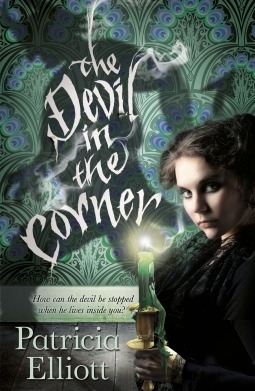
Summary from Goodreads
A gorgeously gothic historical tale from the author of THE PIMPERNELLES
Penniless, and escaping the horrors of life as a governess to brutal households, Maud seeks refuge with the cousin-by-marriage she never knew. But Juliana quashes Maud's emerging friendships with the staff and locals - especially John, the artist commissioned to restore the sinister Doom in the local church. John, however, is smitten with Maud and makes every effort to woo her.
Maud, isolated and thwarted at every turn, continues to take the laudanum which was her only solace in London. Soon she becomes dependent on the drug - so is this the cause of her fresh anxieties? Or is someone - or something - plotting her demise?
Is the devil in the corner of the Doom a reality, or a figment of her imagination?
Paperback, 400 pages
Expected publication: March 6th 2014 by Hachette Children's Books
Guest Post
It is often hard when you've finished a novel to remember exactly how the idea came in the first place. It's rare that they come fully formed but that was the case, almost, with The Devil in the Corner. I remember clearly the moment when it happened and the hairs rose on the back of my neck because I knew there was something there I needed to explore.
We moved to Suffolk two years ago or so. I was told that in our village church there was a unique painting of the Day of Judgement, dating from the late fifteenth century. The village is rightly very proud of it as, unlike other 'Doom' paintings, it was done on wooden boards rather than straight on to the church walls, and so has survived. There is another quite remarkable – you could say, even miraculous - story, too, to its survival: during the Reformation the painting was white-washed over to hide it. Then, when the church was due for refurbishment in 1892, the boards were thrown out into the churchyard to be taken away and destroyed. During the night there was a violent rainstorm that dissolved the white-wash and exposed the extraordinary painting beneath. (Later, I used this in my own novel, with some changes.)
Of course I went to have a look, along with my elder son. We unlatched the door of the church and went in and saw it immediately, propped against the opposite wall in the darkness. It is enormous, roughly five metres across and two and half metres high.
We both gazed in silence.
'Spooky,' I said.
'Too right,' said my son.
Looking at it you are immediately transported into the medieval afterlife. It is an image of the end of time. The Christ is a sternly pitiless figure, sitting in judgement. The dead rise naked from their graves and after their souls are weighed on St Michael's scales, the good are welcomed through the gates of heaven and the bad pursued by spiny, jeering little demons, tails whisking, into the jaws of hell to face a variety of horrible punishments. It is crudely painted but definitely sinister.
The next day I went back alone. There was something I had seen in the painting the day before that intrigued me. Standing alone in the church I saw what it was. Each human face was
individual, different from the others. I wondered suddenly if the painters might have taken the villagers as their models. It struck me that anyone they disliked they could paint in on the hell side of the picture, a great way of getting their own back. If you saw yourself in it afterwards, what would you feel, especially if you had a guilty secret?
So that was the beginning of my novel. My main character, Maud, does have a guilty conscience; she finds the Doom's message as terrifying as those living in medieval times had done. Though she is living in the Victorian period, a time of great advancement and enlightenment, there were still many then who believed in a judgemental God who would punish sinners and condemn them to everlasting hell-fire.
And then one day Maud sees herself in the painting...
Her sweetheart, John, is a Darwinist. If he believes in any God, it is the God of love. Only John can save Maud – if he gets the chance.
In my novel the village of Rending and its church are both fictitious and the Doom is not exactly the Doom in my local church. But I still look at those faces in the Doom and wonder.

Author Bio

Patricia Elliott was born in London, but grew up in Europe and the Far East. A voracious reader since childhood, where she had the resources of ten different school libraries, she also made up ghost stories to scare her friends! As an adult, she worked in publishing in London and in a children's bookshop in New York. She now lives in Wenhaston, near Halesworth in Suffolk, a place that sparked the idea for her new book Devil in the Corner. Her first book, The Ice Boy, won the Fidler Award for a first novel, was shortlisted for the Branford Boase Award and the West Sussex Award. Her second novel, Murkmere, was longlisted for the Guardian Children's Fiction Award.

Nhận xét
Đăng nhận xét